 Ethereum News
Solo stakers prevent Ethereum centralization

Bitmine and the exit queue risk
Bitmine holds 4.9 million ETH. This amount accounts for 12% of the total supply staked. The firm, led by chairman Tom Lee, pays a 9.5% annual fixed dividend to shareholders weekly. Bitmine operates at an 85% utilization rate and holds $11.5 billion in total crypto and cash. If Bitmine is forced to liquidate even a portion of its position to meet its preferred stock dividend obligations, the resulting surge in the exit queue will affect every other validator waiting to withdraw. This concentration creates a dependency that most participants do not price into their target utilization rate. Bitmine has accumulated ETH throughout 2025 and 2026 and holds nearly 5% of the total ETH supply.
The Kiln incident, where 1.6 million ETH unstaked pushed exit queues to 50 days, serves as a reference. Bitmine’s stake is three times larger than that amount. The Glamsterdam upgrade scheduled for Q4 2026 includes EIP-8061. This change increases the exit churn limit four times. It addresses the exit side of the validator queue.
Can entry congestion remain a structural feature?
Yield differences and exchange control
Solo stakers earn 2.5% to 5% in base rewards. They add 0.5% to 1% by using MEV-Boost. Well-operated nodes earn a realistic all-in yield of 3.3% to 3.8%.
Exchanges take much larger cuts. Coinbase takes a 35% commission. Kraken takes between 15% and 30%.
| Feature | Solo Staking | Coinbase | Kraken |
|---|---|---|---|
| Minimum ETH | 32 | None | None |
| Commission | 0% | 35% | 15-30% |
| Net Yield | 3.3-6% | ~1.8% | 1.8-2.0% |
| Control | Full | Custodial | Custodial |
You hold keys.
The Pectra upgrade in May 2025 changed the staking market. EIP-7251 allowed a single validator to hold up to 2,048 ETH. This change reduces operational complexity for large stakers. Centralized models introduce counterparty risk because users do not hold cryptographic keys. In these models, the exchange controls the validator process. Coinbase provides a simple interface for beginners, while Kraken offers more flexible staking options. Most MEV-Boost blocks come from three builder operations. Titan builds 52.16% of blocks.
Hardware requirements and client diversity
Solo stakers maintain client diversity. The 2026 EthStaker survey shows 78 percent of respondents stake 66 to 100 percent of their ETH. Most run validators with their own capital. 59 percent of respondents run between one and five validators.
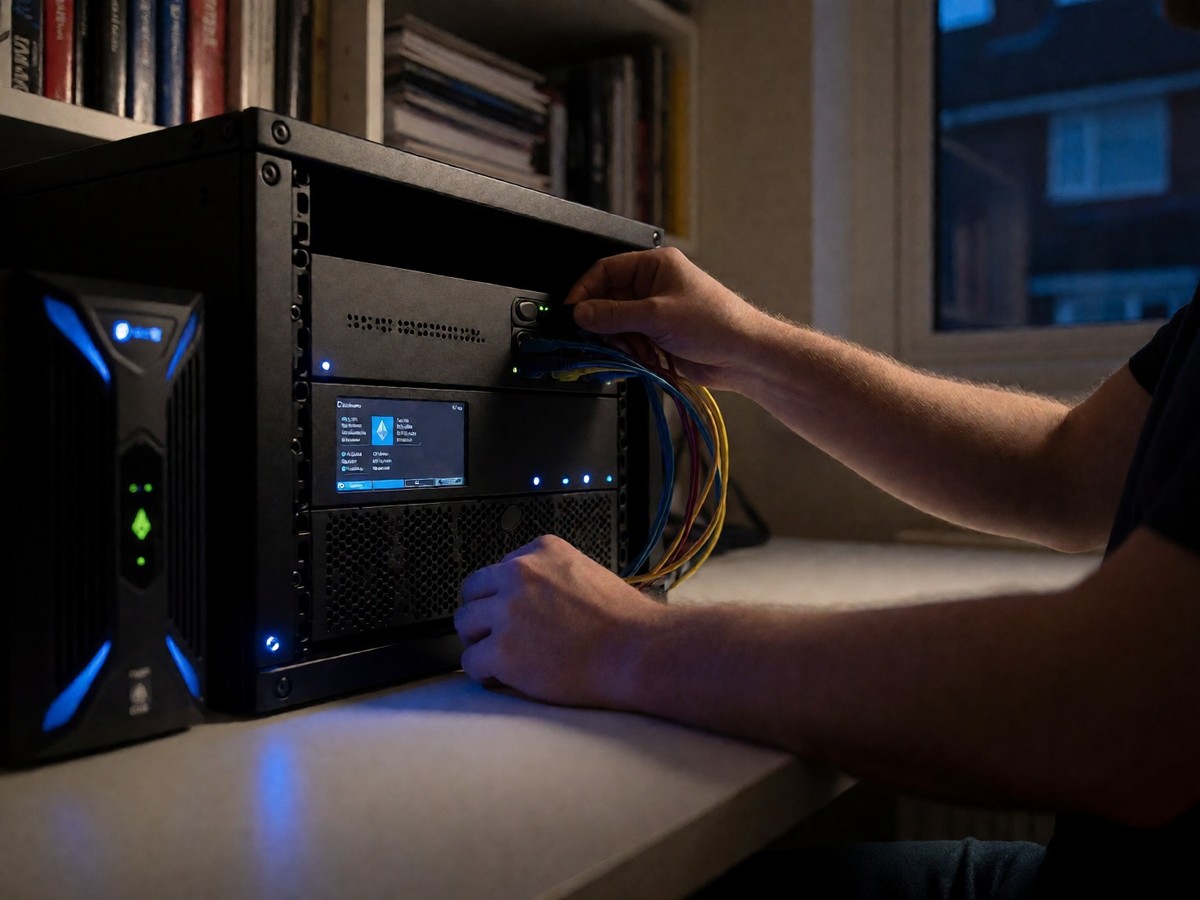
Hardware requirements are strict. A node needs an 8 to 12 core processor with a PassMark single-thread score of at least 3,500. 64GB RAM is the floor. You must use 4 to 8TB of NVMe SSD storage. An uninterruptible power supply prevents database corruption. A dedicated internet connection needs 50+ Mbps of bandwidth.
The verdict: solo staking works.
Users often run Ubuntu 24.04 LTS. Lighthouse and Nethermind are common client pairs. These pairs help avoid the risk of a single client supermajority. If a single client holds a supermajority, a software bug could punish all participating validators. Solo stakers must manage a 32 ETH floor. They must also handle the complexity of BLS signature aggregation as the validator set grows. This process occurs every epoch, which lasts 6.4 minutes.